Steve Voeller, Director of the Arizona Free Enterprise Club, is so wrong on so many levels in his pitch for tax cuts it's scary. To use Charles Goyette's phrase, he needs to "avoid the Kool-Aid."
Voeller continues the lie by saying that the tax cuts alone made the State grow simply ignores reality. Arizona's economy moved from agriculture, mining and tourism to high-tech in the 80's and 90's, which increased the size of the tax base and expanded the real estate market because of the increase in employment. It doesn't snow here, so many people moved here for the climate figuring they'll get a job in the growing tech economy. So is it a shock that people in real estate, computer sales, defense satellite systems, marketing and sales are successful here? Nope.
Why were taxes higher in the first place? Because Arizona didn't have a diverse industrial or economic base back then. We do now. More business means more firms, more jobs and more people contributing to the State treasury. That's what grew revenues, not tax cuts.
According to The Tax Foundation, Arizona's rates are "competitive among all of the states," we rank 39th in income tax rates and we're at the national average with regards to tax burden. Voeller says people making between $50K and $70K should be happy with an additional $117 --per year-- and those with lower incomes would get less. Wow, time to start that investment account or buy a couple tanks of gas.
Most research that looks at why businesses move or why they're started in the first place do NOT includes taxes at the top of the list. It's the market, cost of labor, cost of land, and cost of benefits that lead the list. Does Voeller really expect us to believe that someone will not start a business because of personal income tax rates? Does he think we're stupid? Close. He thinks we're gullible.
Good corporate citizens understand paying taxes makes sure their streets are paved, their businesses are safe, their employee's children are educated and they have safe drinking water, among many other things. Can they be too high? Sure. But Arizona has lower taxes than two-thirds of the States and we have a surplus. LetÂ?s use it wisely on things we need to support the ongoing growth Mr. Voeller can't see is already there.
Saturday, January 14, 2006


Wednesday, January 11, 2006
AZ Republic Letters - Love the Rich, Hate the Poor
In Thursday's Op-Ed section of the Arizona Republic, someone named Michael Slater assumes the poor are poor by choice. What an amazingly uninformed opinion. Research studies (like Peter H. Rossi's classic "Why People Move" and the follow-up "Why Families Move") show the poor don't even like living next to each other. It amazes me people believe some choose to be poor. It's as if a husband and wife sat down and said "Let's be poor and live off the public. Let's live in high-crime areas. Let's live where the school's are crappy." Amazing ignorance.
He also presumes the rich are that way because they work hard. I wonder exactly how Mr. Slater is using the words "rich" and "work." Maybe he should read the Bible for a little perspective.
Deuteronomy 14:21-29 mandates that food be shared with "aliens, orphans, and widows." Hebrews 13:5 states "Make sure that your character is free from the love of money, being content with what you have; for He Himself has said, "I will never desert you, nor will I ever forsake you...” Lack of support for the poor and needy is what got Sodom and Gomorrah destroyed (Ezekiel 16:46-50), not just being selfish. Matthew 25:31-45 describes how we will be judged for how we treat the less fortunate.
God and Jesus tell us we are to care for the poor. I can’t tell whether Mr. Slater is a Christian, but he’s certainly a Conservative. I wouldn’t want to be him or others like him on Judgment Day.
He also presumes the rich are that way because they work hard. I wonder exactly how Mr. Slater is using the words "rich" and "work." Maybe he should read the Bible for a little perspective.
Deuteronomy 14:21-29 mandates that food be shared with "aliens, orphans, and widows." Hebrews 13:5 states "Make sure that your character is free from the love of money, being content with what you have; for He Himself has said, "I will never desert you, nor will I ever forsake you...” Lack of support for the poor and needy is what got Sodom and Gomorrah destroyed (Ezekiel 16:46-50), not just being selfish. Matthew 25:31-45 describes how we will be judged for how we treat the less fortunate.
God and Jesus tell us we are to care for the poor. I can’t tell whether Mr. Slater is a Christian, but he’s certainly a Conservative. I wouldn’t want to be him or others like him on Judgment Day.
Thursday, January 05, 2006
Arizona Republic Argues for Election of More Democrats
Okay, well not exactly...
In today's (1/5/06) lead editorial, the powers that be at the Arizona Republic argue that changes need to be made to change a system that is a "...very flawed, money-driven representative democracy into a far less noble pursuit" into something where lawmakers remember who they work for.
Since Abramoff has "sterling Republican Party connections," doen't it seem plausible that Democrats should take the places of all Republican tainted by the current and coming scandals? Doesn't it seem right that voters should toss out those members of Congress who, as the Republic states has gone through "...the dangerous devolution of a democracy from a system of voters and elected officials to a system that has slipped hired guns in between?"
The Republic says that "Out of the coming headline-grabbing scandals, "reform" will certainly come. We ought to be wary of that, too." Using the typical conservative spin, why change the system with the current batch of people who will cover their own behinds in an effort to stay in office. I say elect Democrats to those seats and then do the reform.
Throw the bums out!
In today's (1/5/06) lead editorial, the powers that be at the Arizona Republic argue that changes need to be made to change a system that is a "...very flawed, money-driven representative democracy into a far less noble pursuit" into something where lawmakers remember who they work for.
Since Abramoff has "sterling Republican Party connections," doen't it seem plausible that Democrats should take the places of all Republican tainted by the current and coming scandals? Doesn't it seem right that voters should toss out those members of Congress who, as the Republic states has gone through "...the dangerous devolution of a democracy from a system of voters and elected officials to a system that has slipped hired guns in between?"
The Republic says that "Out of the coming headline-grabbing scandals, "reform" will certainly come. We ought to be wary of that, too." Using the typical conservative spin, why change the system with the current batch of people who will cover their own behinds in an effort to stay in office. I say elect Democrats to those seats and then do the reform.
Throw the bums out!
Wednesday, January 04, 2006
Creationism redux
In today's Arizona Republic, Robert Robb makes the claim that Intelligent Design (ID) really IS science and is not the same as creationism. He criticizes Federal District Court judge John E. Jones III (a GWB appointee, by the way) for tossing out the Dover School Board policy of teaching ID after painstakingly dissecting their arguments. He belittles the judge for becoming an authority on ID "based upon the extensive expertise he professes to have acquired in the course of a six-week trial."
So let me get this straight, the Dover School Board brought in the best people in the ID movement to testify on their behalf and for their position before this Bush-appointed judge and even though the judge heard their testimony, Robert Robb thinks the judge still got it wrong. Robb thinks there is so much more evidence that he personally knows that was somehow missed by the Dover School Board and their experts that should have been presented before the court that if the judge had been doing his job would clearly have discovered and ruled in favor of ID. He argues that even "some" scientists can't get the start of life quite right.
Since Mr. Robb can't seem to buy a clue, I'll give him a couple.
1. The title of Darwin's book is "The Origin of Species" --NOT-- "The Origin of The Species." Big difference.
2. Evolution explains how life adapts to changes in environments. If someone would actually read Darwin, it concerns itself more with species and how they got to where they are today, not so much how it began.
3. Darwinism's "explanation" of the birth of all life is NOT included in "The Origin of Species." It is an additional theory developed by other scientists using Darwin's theory and going backwards. To criticize Darwin's theory for being wrong on the creation of life is to clearly not know Darwin's theory.
4. The father of the ID movement, Phillip E. Johnson wrote "All I want them to do is to be candid about the disconfirming evidence and admit, if it is the case, that they are hanging on to Darwinism only because they prefer a shaky theory to having no theory at all." Shouldn't the same statement apply to "creationists?" Shouldn't the same statement apply to ID folks?
If Mr. Robb would read the Kitzmiller v. Dover School Board decision, he'll see the judge based his decision on the testimony before him. That Robb and others still think there's other evidence that could have turned the decision, shame on the ID folks for lying to the court, exaggerating points, and bringing a conservative judge to rule against ID. Maybe, just maybe the judge made the correct ruling.
The bottom line to all of this is that no matter what, no one will ever know the answer. If faith is what drives you, then faith will drive your thinking, much like if you want proof, science will drive your thinking. At the end of the day, we will all be dead before we learn the answer. At that point, it's too late to phone home.
So let me get this straight, the Dover School Board brought in the best people in the ID movement to testify on their behalf and for their position before this Bush-appointed judge and even though the judge heard their testimony, Robert Robb thinks the judge still got it wrong. Robb thinks there is so much more evidence that he personally knows that was somehow missed by the Dover School Board and their experts that should have been presented before the court that if the judge had been doing his job would clearly have discovered and ruled in favor of ID. He argues that even "some" scientists can't get the start of life quite right.
Since Mr. Robb can't seem to buy a clue, I'll give him a couple.
1. The title of Darwin's book is "The Origin of Species" --NOT-- "The Origin of The Species." Big difference.
2. Evolution explains how life adapts to changes in environments. If someone would actually read Darwin, it concerns itself more with species and how they got to where they are today, not so much how it began.
3. Darwinism's "explanation" of the birth of all life is NOT included in "The Origin of Species." It is an additional theory developed by other scientists using Darwin's theory and going backwards. To criticize Darwin's theory for being wrong on the creation of life is to clearly not know Darwin's theory.
4. The father of the ID movement, Phillip E. Johnson wrote "All I want them to do is to be candid about the disconfirming evidence and admit, if it is the case, that they are hanging on to Darwinism only because they prefer a shaky theory to having no theory at all." Shouldn't the same statement apply to "creationists?" Shouldn't the same statement apply to ID folks?
If Mr. Robb would read the Kitzmiller v. Dover School Board decision, he'll see the judge based his decision on the testimony before him. That Robb and others still think there's other evidence that could have turned the decision, shame on the ID folks for lying to the court, exaggerating points, and bringing a conservative judge to rule against ID. Maybe, just maybe the judge made the correct ruling.
The bottom line to all of this is that no matter what, no one will ever know the answer. If faith is what drives you, then faith will drive your thinking, much like if you want proof, science will drive your thinking. At the end of the day, we will all be dead before we learn the answer. At that point, it's too late to phone home.
Tuesday, January 03, 2006
Tax cut irrationale #4
There are so many misleading statements in Tom Patterson's East Valley Tribune (State doesn't 'invest'; it spends) commentary today (Tuesday) it's hard to know where to start.
Mr. Patterson says the state surplus will be in "the $1 trillion range." Odd, I was at a meeting where one of the Governor's staffers spoke last month and they said it would be closer to $500 million. There's a pretty big difference $1 trillion and $500 million. Not that I know the correct number, but wouldn't it be nice if someone who's pitching another tax cut could at least get an accurate figure? So let's say it's the lesser number. What does that do for Patterson's tax-cut pitch? In my view, it doesn't help his case.
Next, Patterson states that government can't invest because in his dictionary it means "using money to generate interest or profit." According to the "Dictionary of Modern Economics," the word investment describes "the flow of expenditures devoted to projects producing goods which are not intended for current consumption. These investment projects may take the form of adding to both physical and human capital as well as inventories. (p. 224)" Not quite the same thing, is it?
From a government perspective, adding to physical capital clearly means roads, school buildings, police cars, fire trucks, sewer and water systems, waste handling and the like. I'm constantly amazed that people like Mr. Patterson seem to think this stuff just appears and has no cost. He talks about the importance of growth but seems to have zero clue as to the public infrastructure required to support that growth at all levels. Buying things like fire and police stations and school buildings are, Mr. Patterson, an i-n-v-e-s-t-m-e-n-t and one that you should be supporting.
He makes the misleading comment that if the legislature passed a 10 percent tax cut that this would magically result in all taxpayers being able to "boost their investing and spending." Again, I'm amazed that someone who's supposed to be running an economic analysis organization would make such a silly statement. Maybe Mr. Patterson hasn't noticed the price of gasoline. Maybe Mr. Patterson hasn't seen the cost of kid's clothing. Maybe Mr. Patterson hasn't seen the cost of food lately. After people are done "spending" on necessities, they don't have money left over to use for Mr. Patterson's definition of "investing."
The Congressional Budget Office published a report on December 1, 2005 that shows that the supply-side theory used by Patterson with regards to increases in government revenues doesn't work. Addressing supply-side theory, the CBO states "there is insufficient theoretical and empirical basis for (supply-side) effects to allow CBO to incorporate them in (its) analysis." Isn't that interesting that Mr. Patterson says there is "economic research that tells a different story.” How come the CBO can’t find it?
The CBO report shows, in its best case, a 10 percent tax cut made up only 25% of the lost revenue, which means a higher deficit in near and long term. Patterson simply ignores the increased risk of debt should revenues not keep up with required i-n-v-e-s-t-m-e-n-t. What happens if the economy gets rough again? Then what, Mr. Patterson?
I tried to find Richard K. Vedder's research, but even using Google, I couldn't do it. One paper I did find and read made the comical assertion that taxes had a negative impact on people's income living under the poverty line and that was a bad thing.
Well, duh.
Of course it has an impact because a five percent tax on an income of $12,000 per year is a much bigger bite that five percent on an income of $150,000, and that doesn't account for the itemized deductions the person making $150,000 gets to take. Maybe that's why tax cuts should go to the lower income people and not the upper income crowd. It seems to me rather insincere for Mr. Patterson to feign worry about poor folk's incomes while at the same time championing higher personal investment. As if...
Continuing to live in the past, Patterson cites a 1997 study that shows when tax rates were cut, the Arizona per-capita income and earnings per-employee improved. What he doesn’t say is that Arizona’s current tax rates, according to The Tax Foundation, are “competitive compared to other states.” He also doesn’t mention that Arizona’s income tax rates ranks 39th out of 50 states and the tax burden is right at the national average.
Clearly there’s no pleasing Mr. Patterson. We have a growing economy with lower tax rates than in the last decade and we have a surplus. Good for us. It could be worse. We also have a clear need for more investment in community infrastructure and yes, programs. Since the real definition of investment means expenditures devoted to improving physical and human capital, maybe putting money where it’s needed and paying down debt is a good idea. Who knows when we may get the chance again.
Mr. Patterson says the state surplus will be in "the $1 trillion range." Odd, I was at a meeting where one of the Governor's staffers spoke last month and they said it would be closer to $500 million. There's a pretty big difference $1 trillion and $500 million. Not that I know the correct number, but wouldn't it be nice if someone who's pitching another tax cut could at least get an accurate figure? So let's say it's the lesser number. What does that do for Patterson's tax-cut pitch? In my view, it doesn't help his case.
Next, Patterson states that government can't invest because in his dictionary it means "using money to generate interest or profit." According to the "Dictionary of Modern Economics," the word investment describes "the flow of expenditures devoted to projects producing goods which are not intended for current consumption. These investment projects may take the form of adding to both physical and human capital as well as inventories. (p. 224)" Not quite the same thing, is it?
From a government perspective, adding to physical capital clearly means roads, school buildings, police cars, fire trucks, sewer and water systems, waste handling and the like. I'm constantly amazed that people like Mr. Patterson seem to think this stuff just appears and has no cost. He talks about the importance of growth but seems to have zero clue as to the public infrastructure required to support that growth at all levels. Buying things like fire and police stations and school buildings are, Mr. Patterson, an i-n-v-e-s-t-m-e-n-t and one that you should be supporting.
He makes the misleading comment that if the legislature passed a 10 percent tax cut that this would magically result in all taxpayers being able to "boost their investing and spending." Again, I'm amazed that someone who's supposed to be running an economic analysis organization would make such a silly statement. Maybe Mr. Patterson hasn't noticed the price of gasoline. Maybe Mr. Patterson hasn't seen the cost of kid's clothing. Maybe Mr. Patterson hasn't seen the cost of food lately. After people are done "spending" on necessities, they don't have money left over to use for Mr. Patterson's definition of "investing."
The Congressional Budget Office published a report on December 1, 2005 that shows that the supply-side theory used by Patterson with regards to increases in government revenues doesn't work. Addressing supply-side theory, the CBO states "there is insufficient theoretical and empirical basis for (supply-side) effects to allow CBO to incorporate them in (its) analysis." Isn't that interesting that Mr. Patterson says there is "economic research that tells a different story.” How come the CBO can’t find it?
The CBO report shows, in its best case, a 10 percent tax cut made up only 25% of the lost revenue, which means a higher deficit in near and long term. Patterson simply ignores the increased risk of debt should revenues not keep up with required i-n-v-e-s-t-m-e-n-t. What happens if the economy gets rough again? Then what, Mr. Patterson?
I tried to find Richard K. Vedder's research, but even using Google, I couldn't do it. One paper I did find and read made the comical assertion that taxes had a negative impact on people's income living under the poverty line and that was a bad thing.
Well, duh.
Of course it has an impact because a five percent tax on an income of $12,000 per year is a much bigger bite that five percent on an income of $150,000, and that doesn't account for the itemized deductions the person making $150,000 gets to take. Maybe that's why tax cuts should go to the lower income people and not the upper income crowd. It seems to me rather insincere for Mr. Patterson to feign worry about poor folk's incomes while at the same time championing higher personal investment. As if...
Continuing to live in the past, Patterson cites a 1997 study that shows when tax rates were cut, the Arizona per-capita income and earnings per-employee improved. What he doesn’t say is that Arizona’s current tax rates, according to The Tax Foundation, are “competitive compared to other states.” He also doesn’t mention that Arizona’s income tax rates ranks 39th out of 50 states and the tax burden is right at the national average.
Clearly there’s no pleasing Mr. Patterson. We have a growing economy with lower tax rates than in the last decade and we have a surplus. Good for us. It could be worse. We also have a clear need for more investment in community infrastructure and yes, programs. Since the real definition of investment means expenditures devoted to improving physical and human capital, maybe putting money where it’s needed and paying down debt is a good idea. Who knows when we may get the chance again.
Sunday, January 01, 2006
The Impact of the War on Christmas
Maybe there really IS a "liberal War on Christmas." In case you've had your head in the sand, the conservative talking heads like Fox's John Gibson and Bill O'Reilly say "it's all part of the secular progressive agenda ... to get Christianity and spirituality and Judaism out of the public square." He then added: "[B]ecause if you look at what happened in Western Europe and Canada, if you can get religion out, then you can pass secular progressive programs, like legalization of narcotics, euthanasia, abortion at will, gay marriage, because the objection to those things is religious-based, usually."
I have to say I was very skeptical. After all, I haven't heard anyone want "abortion at will" (other than conservatives), or legalizing narcotics (other than conservatives), but it wasn't until I saw the devastating impact on Santa here in Arizona I started thinking maybe there was something to it. To show you what I mean, I took these disturbing photos of Santa here in Arizona. Needless to say, Santa here has been devastated. The only possible answer must be "the War on Christmas."
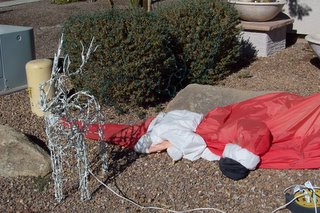
"I feel like the all of the air has just been taken out of me" said one Santa, who refused to allow himself to be identified. "I can't even get the reindeer to eat. Look at them, they're so boney. You can almost see right through them. Look at me, I've fallen and I can't get up."

The second is another startling picture (please don't show the children). This distraught Santa is so out of it that he is barely able to keep himself from jumping off the balcony of this home! "Nothing matters any more," said this Santa. "Those liberals have simply robbed from me the power to stand on my own anymore. Even the Christmas trees can't get juiced up over the holiday anymore."
From what I understand, it's not just Arizona. It's everywhere. Santas, Christmas trees, snowmen and even elfs have had the wind knocked out of them by this "war on Christmas." Clearly, the holiday won't be the same, anymore.
Oh, Happy New Year!
I have to say I was very skeptical. After all, I haven't heard anyone want "abortion at will" (other than conservatives), or legalizing narcotics (other than conservatives), but it wasn't until I saw the devastating impact on Santa here in Arizona I started thinking maybe there was something to it. To show you what I mean, I took these disturbing photos of Santa here in Arizona. Needless to say, Santa here has been devastated. The only possible answer must be "the War on Christmas."
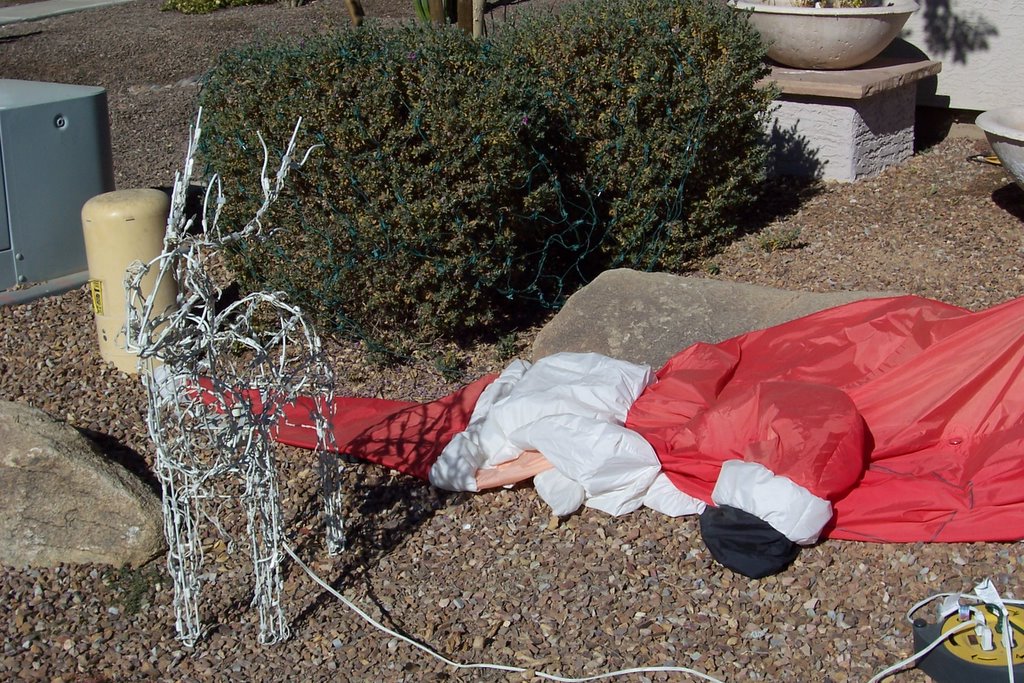
"I feel like the all of the air has just been taken out of me" said one Santa, who refused to allow himself to be identified. "I can't even get the reindeer to eat. Look at them, they're so boney. You can almost see right through them. Look at me, I've fallen and I can't get up."

The second is another startling picture (please don't show the children). This distraught Santa is so out of it that he is barely able to keep himself from jumping off the balcony of this home! "Nothing matters any more," said this Santa. "Those liberals have simply robbed from me the power to stand on my own anymore. Even the Christmas trees can't get juiced up over the holiday anymore."
From what I understand, it's not just Arizona. It's everywhere. Santas, Christmas trees, snowmen and even elfs have had the wind knocked out of them by this "war on Christmas." Clearly, the holiday won't be the same, anymore.
Oh, Happy New Year!
Monday, December 26, 2005
Conservatives to ASU Michael Crow - Hire more staff with "Conservative Ideology" or else
Today's East Valley Tribune "Voice" op-ed piece was written by some guy named Roy Miller and suggests ASU President Michael Crow should "row the boat to the right in order to achieve the growth he envisions." This veiled threat is in response to Mr. Miller is ("a Phoenix businessman and graduate of the ASU Business College") belief that there's too many damn lefties teaching at ASU, and if Crow knows what's best for him and ASU, he needs to hire more faculty who are "Republicans" and hold a "conservative ideology." Otherwise, Republicans and conservatives will cut funding.
He cites a Hoover Institute (now THERE'S an unbiased source) study that purportedly says there are lots of colleges with "no Republicans at all."
Oh...My...God!
The study one supposes he's citing is titled "Impostors in the Temple: A Blueprint for Improving Higher Education in America." It was published in, get this, 1992. This is "The most recent study I (Miller) encountered." Hmm, 13 years old?!
Wow. Let's change ASU now!
I think Mr. Miller needs to get out more often. I wonder why he didn't mention the year of the study. Hmmm.
He says that "Conservative parents of college-age students who have raised (does he mean indoctrinated?) their children to believe in conservative ideas" should consider sending their kids to other schools because at ASU they may be "turned to the left by the ASU faculty."
Oh...My...God!!
Mr. Miller is engaging what is commonly called "spreading bullshit." Not only does he want us to think he is somehow an expert on ASU because he went there, he also wants us to think he's an expert on the effects of universities to transform conservative kids into lefties because he attended a conference. He also wants us to think that parents who want to politically indoctrinate their kids even further can't send them to private colleges and universities instead. This, ladies and gentlemen, is classic bullshit. He is a non-expert talking out of his posterior and hoping the public buys it.
Miller just doesn't get that education and research and exposure to new ideas and thoughts is what drives college professors to be "lefties" (besides getting themselves hired in the first place). Conservative ideology is not one that lends itself to open discussions of things that are true, different, or which questions dogma. Ideology, by its nature and definition, precludes any search for the truth. Ideologues don't want kids to know the truth. Miller doesn't want kids to know the truth otherwise how would these students be "turned to the left?"
Roy Miller makes the perfect case of why ASU needs to stay the way it is: to open people's eyes.
He cites a Hoover Institute (now THERE'S an unbiased source) study that purportedly says there are lots of colleges with "no Republicans at all."
Oh...My...God!
The study one supposes he's citing is titled "Impostors in the Temple: A Blueprint for Improving Higher Education in America." It was published in, get this, 1992. This is "The most recent study I (Miller) encountered." Hmm, 13 years old?!
Wow. Let's change ASU now!
I think Mr. Miller needs to get out more often. I wonder why he didn't mention the year of the study. Hmmm.
He says that "Conservative parents of college-age students who have raised (does he mean indoctrinated?) their children to believe in conservative ideas" should consider sending their kids to other schools because at ASU they may be "turned to the left by the ASU faculty."
Oh...My...God!!
Mr. Miller is engaging what is commonly called "spreading bullshit." Not only does he want us to think he is somehow an expert on ASU because he went there, he also wants us to think he's an expert on the effects of universities to transform conservative kids into lefties because he attended a conference. He also wants us to think that parents who want to politically indoctrinate their kids even further can't send them to private colleges and universities instead. This, ladies and gentlemen, is classic bullshit. He is a non-expert talking out of his posterior and hoping the public buys it.
Miller just doesn't get that education and research and exposure to new ideas and thoughts is what drives college professors to be "lefties" (besides getting themselves hired in the first place). Conservative ideology is not one that lends itself to open discussions of things that are true, different, or which questions dogma. Ideology, by its nature and definition, precludes any search for the truth. Ideologues don't want kids to know the truth. Miller doesn't want kids to know the truth otherwise how would these students be "turned to the left?"
Roy Miller makes the perfect case of why ASU needs to stay the way it is: to open people's eyes.
Wednesday, December 21, 2005
Where do they FIND these people?
Subscribing to the EV Tribune as a "moderate" voter can be frustrating. How they ask people to contribute commentaries is purely a mystery because it seems that people who should know better are often published making some of the most baseless comments imaginable. Take for example today's "East Valley Voice" column by someone named Bill Sandry. Now, I'm not sure what Mr. Sandry's credentials are, but it seems to me a well-based knowledge of civics just isn't on that list. Here's why I say this.
In his op-ed piece titled "Keep judges out of the classroom," he wonders what there is in the constitution that gives judges power of the legislative branch. He says "We have constitutionally vested these responsibilities in our elected legislative body. Where does the judiciary find its constitutional mandate or authority to usurp these powers from the legislature?"
He goes on to say "How, why and under what constitutional authority does a judge find the power to establish the educational standards for graduating from high school? Who is he to determine who should be required to or exempted from passing the same tests or standards as other students?"
I find the fact that he's wondering where the power comes from as startling. Mr. Sandry doesn't consider the courts to be a check on the legislature? If the legislature simply does not do what the federal law directs, it seems to me quite reasonable that a judge would place sanctions on the legislature for not getting the job done and providing relief for those harmed by the legislature's inaction.
Mr. Sandry says "If a judge (federal in this case) is overreaching and extends his authority into powers reserved for another branch of government (the legislature), where is the check and balance in our system to make a constitutional course correction.
Ummm, the legislature can do their job properly and comply with the judge's order? Duh!
He concludes with this after admitting most of the educational funds come from the federal government (who set the rules, by the way): "Our elected officials, not a judge, should be making the societal and educational decisions concerning what should be done and how much funding is appropriate for educating students in Arizona."
I repeat --Duh!! They didn't and the judge is making sure they follow the law. God forbid the Arizona legislature follow the rules in this "nation of laws."
Where do they FIND these people!
In his op-ed piece titled "Keep judges out of the classroom," he wonders what there is in the constitution that gives judges power of the legislative branch. He says "We have constitutionally vested these responsibilities in our elected legislative body. Where does the judiciary find its constitutional mandate or authority to usurp these powers from the legislature?"
He goes on to say "How, why and under what constitutional authority does a judge find the power to establish the educational standards for graduating from high school? Who is he to determine who should be required to or exempted from passing the same tests or standards as other students?"
I find the fact that he's wondering where the power comes from as startling. Mr. Sandry doesn't consider the courts to be a check on the legislature? If the legislature simply does not do what the federal law directs, it seems to me quite reasonable that a judge would place sanctions on the legislature for not getting the job done and providing relief for those harmed by the legislature's inaction.
Mr. Sandry says "If a judge (federal in this case) is overreaching and extends his authority into powers reserved for another branch of government (the legislature), where is the check and balance in our system to make a constitutional course correction.
Ummm, the legislature can do their job properly and comply with the judge's order? Duh!
He concludes with this after admitting most of the educational funds come from the federal government (who set the rules, by the way): "Our elected officials, not a judge, should be making the societal and educational decisions concerning what should be done and how much funding is appropriate for educating students in Arizona."
I repeat --Duh!! They didn't and the judge is making sure they follow the law. God forbid the Arizona legislature follow the rules in this "nation of laws."
Where do they FIND these people!
Tuesday, December 20, 2005
If I lived in Mesa, I'd be pissed
Today's EV Tribune's headline is "Mesa puts property tax vote on hold." The city is looking at a $37 million (yup, that's 37 with six zeros after it) in a deficit. The city has two choices to raise the money: increase the sales tax or institute a property tax. Since all of the Mesa City Council are Republicans, you can guess what happened at their meeting last night: they couldn't decide or take responsibility for fixing the city's problems. Plastered with photos of the council members with hands over their faces, the captions are telling:
Councilman Rex Griswold said "I'd rather not give a blank check to government."
Councilman Tom Rawles said "Why should I give you another chance to steal from me?"
Mayor Keno Hawker said "I'm not comfortable with government having that kind of power."
What a bunch of cowards. Every single one of them should be impeached for dereliction of duty. Faced with a crisis, what do they do? They punt with ideological fervor.
Disgusting and shameful. Can't do what's right. They would rather tow the "government is the enemy" line of conservative Republicanism than accept reality.
Cowards. Plain and simple. They should all lose their jobs.
Councilman Rex Griswold said "I'd rather not give a blank check to government."
Councilman Tom Rawles said "Why should I give you another chance to steal from me?"
Mayor Keno Hawker said "I'm not comfortable with government having that kind of power."
What a bunch of cowards. Every single one of them should be impeached for dereliction of duty. Faced with a crisis, what do they do? They punt with ideological fervor.
Disgusting and shameful. Can't do what's right. They would rather tow the "government is the enemy" line of conservative Republicanism than accept reality.
Cowards. Plain and simple. They should all lose their jobs.
The two-faces of Republican Conservatism
With all the hoopla about last weekend's revelation about President Bush's authorizing warrantless spying on American citizens, isn't it interesting that the same people who loudly argue for strict interpretation of the Constitution when it comes to judicial appointments and limiting women's rights are the same people who want to read into the Constitution the right of a President to spy on American citizens without a warrant or judicial oversight?
The American people are finally getting a chance to see the two faces of the Bush administration and their supporters.
The American people are finally getting a chance to see the two faces of the Bush administration and their supporters.
Wednesday, December 14, 2005
Tax-cut irrationale #3
Today's E.V. Tribune printed another opinion piece from Goldwater Institute economist who thinks we need to cut taxes instead of investing the money in services to support growth. Titled "Gift that keeps giving: Eliminate income tax," Noah Clarke argues we need tax cuts to stimulate Arizona's economy.
"Arizona's best economic interest lies in returning surplus funds to taxpayers," Clarke writes. "A permanent reduction in the personal income tax rate will expand private enterprise, entrepreneurial activity, increase employment, and raise wages." In other words, cut taxes and the benefits will trickle down throughout the economy. Arguing trickle-down economics is another academic discussion, but for the sake of proving their point as short-sighted, let's assume the tax cuts DO what he says. What does that mean?
Let's say that Arizona's population grows at the rate ASU predicts, which is doubling to 11.2 million people by 2030. That's an average of 224,000 people per year. Let's say further that of those 224,000 people, there is a husband, wife and two kids. So that's 112,000 kids that will need seats in schools. That 112,000 families per year that will want home, water, sewer, and waste services. That's 112,000 families that will want police protection, want fire protection, want parks, want sports facilities, and need roads to drive to them.
He says lower tax rates could create one new firm for every 303 people. Okay, so that's 739 new businesses per year, each of which will increase demands for commercial office space, who wil then, too, need employees, and will demand the same services as families. Like so many conservatives, Clarke can't think ahead. He thinks all of these funds will come from future tax receipts and will be in place at just the right time.
The problem is all of these will be required as they arrive. There is no lag time.
He also makes the ridiculous comparison of Arizona's income tax-based government with Nevada's. Yes, there's no income tax in Nevada, they don't need one. They have casinos. Is Clarke suggesting Arizona become another haven for casinos? If not, then the argument is simply irresponsible and nonsensical. The basis of these economies are not the same. Never were, never will be.
The belief that government cannot possibly use the money for the betterment of society is about as specious an argument as one can make. Government investing in the future is no different from families investing in their future. It's the right thing to do.
"Arizona's best economic interest lies in returning surplus funds to taxpayers," Clarke writes. "A permanent reduction in the personal income tax rate will expand private enterprise, entrepreneurial activity, increase employment, and raise wages." In other words, cut taxes and the benefits will trickle down throughout the economy. Arguing trickle-down economics is another academic discussion, but for the sake of proving their point as short-sighted, let's assume the tax cuts DO what he says. What does that mean?
Let's say that Arizona's population grows at the rate ASU predicts, which is doubling to 11.2 million people by 2030. That's an average of 224,000 people per year. Let's say further that of those 224,000 people, there is a husband, wife and two kids. So that's 112,000 kids that will need seats in schools. That 112,000 families per year that will want home, water, sewer, and waste services. That's 112,000 families that will want police protection, want fire protection, want parks, want sports facilities, and need roads to drive to them.
He says lower tax rates could create one new firm for every 303 people. Okay, so that's 739 new businesses per year, each of which will increase demands for commercial office space, who wil then, too, need employees, and will demand the same services as families. Like so many conservatives, Clarke can't think ahead. He thinks all of these funds will come from future tax receipts and will be in place at just the right time.
The problem is all of these will be required as they arrive. There is no lag time.
He also makes the ridiculous comparison of Arizona's income tax-based government with Nevada's. Yes, there's no income tax in Nevada, they don't need one. They have casinos. Is Clarke suggesting Arizona become another haven for casinos? If not, then the argument is simply irresponsible and nonsensical. The basis of these economies are not the same. Never were, never will be.
The belief that government cannot possibly use the money for the betterment of society is about as specious an argument as one can make. Government investing in the future is no different from families investing in their future. It's the right thing to do.
Monday, December 12, 2005
Gorman shows why Republicans can't be trusted with a "Veto-proof" legislature
Pamela Gorman's attempt in today's Arizona Republic opinion section "Napolitano undermining border reform" to compare Governor Napolitano's veto of Senate Bill 1306 to John Kerry’s war votes misleads the public on the reasons for the Governor’s veto and highlights why Republicans do not deserve a “veto-proof” legislature. As for the Republic, why do they print this crap? This isn't even close to being neatly argued. If I lived in District 6, I'd be embarrased my representative wrote this (if she, in fact, did write it).
Back to the point. Had Rep. Gorman read the Governor's veto letter she would know the reasons were two-fold. First, it was unnecessary as local law enforcement already had the ability work closely with federal agents to “…help support the effort to rid our communities of illegal aliens.” Nothing like passing laws we don’t need.
Second, Republicans passed the bill but didn’t include a penny to cover the costs, which were estimated by DPS and the City of Phoenix to be $10 million and $19 million respectively. Nothing like passing a law without funding proper implementation. Thank you Mrs. Gorman for pointing out that Republicans have passed unfunded mandates for unnecessary laws.
Though not her intention, Rep. Gorman proved the Governor knew law enforcement’s capabilities better than the legislature and why the Republicans can’t be trusted with a “veto-proof” legislature. Just what we need, unnecessary laws that requires we spend money they don’t appropriate. Governor Napolitano, did the right thing.
Back to the point. Had Rep. Gorman read the Governor's veto letter she would know the reasons were two-fold. First, it was unnecessary as local law enforcement already had the ability work closely with federal agents to “…help support the effort to rid our communities of illegal aliens.” Nothing like passing laws we don’t need.
Second, Republicans passed the bill but didn’t include a penny to cover the costs, which were estimated by DPS and the City of Phoenix to be $10 million and $19 million respectively. Nothing like passing a law without funding proper implementation. Thank you Mrs. Gorman for pointing out that Republicans have passed unfunded mandates for unnecessary laws.
Though not her intention, Rep. Gorman proved the Governor knew law enforcement’s capabilities better than the legislature and why the Republicans can’t be trusted with a “veto-proof” legislature. Just what we need, unnecessary laws that requires we spend money they don’t appropriate. Governor Napolitano, did the right thing.
When is a law not a law? When it affects Republicans
Why is it that whenever a Republican is somehow thwarted by some law, the right-wing media machine comes out and claims how unjust it is. Just like Tom DeLay is the victim of a "over zealous" prosecutor seeking to enforce the law, the E.V. Tribune believes it is okay for temporary Scottsdale "lawmaker" David Burnell Smith to ignore the Clean Elections law and ignore the very contract he signed saying he would abide by rules of the Arizona Clean Elections Act.
Hmm, a "lawmaker" ignoring an inconvenient law passed by Arizona's voters? How quaint.
It's okay to ignore a contract with the Arizona voters? How honorable.
A violation of his constitutional rights, they say. Really? Which Article in the Constitution states that someone has the right to win an election by breaking the law? Where does it state in the Constitution that "lawmakers" are immune from being bound by legal contracts? Can someone please state the Article for me?
Smith should do the right thing and give up his seat. If he doesn't, anyone and anything that supports his fraudulent claim on office needs to be held up for what they really are: hypocrites.
Hmm, a "lawmaker" ignoring an inconvenient law passed by Arizona's voters? How quaint.
It's okay to ignore a contract with the Arizona voters? How honorable.
A violation of his constitutional rights, they say. Really? Which Article in the Constitution states that someone has the right to win an election by breaking the law? Where does it state in the Constitution that "lawmakers" are immune from being bound by legal contracts? Can someone please state the Article for me?
Smith should do the right thing and give up his seat. If he doesn't, anyone and anything that supports his fraudulent claim on office needs to be held up for what they really are: hypocrites.
Sunday, December 11, 2005
The Arizona Republic Tax-cut Hype Machine Is On
Robert Robb continues his theory and hyped argument for tax cuts in a column in today's Arizona Republic. Citing his favorite economic theorists (Laffer and Reagan), Robb argues that tax cuts are the things that make state incomes grow. As I have argued before, supply-side theory requires a growing economy and increases in jobs in order to work, so what may work now in Arizona doesn't mean it will work next year or the year after that. Once cuts are instituted it will be damn near impossible to get them back. I think Mr. Robb would do well to think more about the problems facing communities and states experiencing rapid growth and how government can support that growth besides worrying about making sure large corporations get tax breaks.
Where does Robert Robb think new school buildings come from? Trailers?
How does Robert Robb think roads get built? Osmosis?
How does Robert Robb think we get the money to fund police and fire service? Federal grants?
What economic theory do these notions come from?
These services are things growing communities AND businesses require and all have a responsibility to share the cost and invest in their establishment. It is irresponsible for politicians and columnists to take the provision and importance of public services for granted to the point they recklessly advocate cutting the funds desperately needed to provide those that are the result of economic growth.
We should thank our lucky stars that we have an expanding economy when so many other parts of the country do not. LetÂ’s use the money to invest in our growth, our communities and our children. All of our lives will be better for it.
Where does Robert Robb think new school buildings come from? Trailers?
How does Robert Robb think roads get built? Osmosis?
How does Robert Robb think we get the money to fund police and fire service? Federal grants?
What economic theory do these notions come from?
These services are things growing communities AND businesses require and all have a responsibility to share the cost and invest in their establishment. It is irresponsible for politicians and columnists to take the provision and importance of public services for granted to the point they recklessly advocate cutting the funds desperately needed to provide those that are the result of economic growth.
We should thank our lucky stars that we have an expanding economy when so many other parts of the country do not. LetÂ’s use the money to invest in our growth, our communities and our children. All of our lives will be better for it.
Thursday, December 08, 2005
AZ Republican Chair Opposes Anyone Knowing Anyone!
Keeping up with time honored Republican tradition of smearing anyone who has a different opinion, ex-gubernatorial loser Matt Salmon and the Arizona Republican Committee have put out a new "Internet" ad blasting Democratic Senate Candidate Jim Pederson. So smartly titled "The Pederson Bunch," the ad attempts to paint Jim Pederson in a big nasty "liberal" by highlighting meetings with famous "liberals," making legal campaign donations, and any other inferred evilness gained simply, it seems, by osmosis.
According to Matt, here's why Jim Pederson is a "liberal:"
1. Gave money to the Democrats candidates
2. Gave money to organize the Arizona Democratic Party
3. Wanted to unseat elected Republicans
4. He "knows" people
Now are any of these things "illegal?" Nope.
Gee, using Matt's standards, it's a good thing no Arizona Republican got money from Jack Abramoff and his questionable campaign donations. Oh wait, J.D. Hayworth got $64,530 and John Shadegg got $2,500. Okay, so scratch this one.
Gee, using Matt's standards, it's a good thing no Arizona Republicans in authority donated money to candidates or the local parties. Oh, wait. Rick Renzi contributed $100,000 to the state party, which then transferred the money to the Federal office, which could use the money however they wanted--even to support Rick (is it true he's a "carpet-bagger?") Renzi. And most Republican contributions in Arizona come from PACs, so the money being spent isn't as easy to track to individuals. At least Jim Pederson had the courage to do things out in the open.
Gee, using Matt's standards, it's a good thing Republicans don't want to defeat elected Democrats. Oh, wait, that's Matt's job.
Gee, using Matt's standards, it's a good thing Republicans don't "know" people with unpopular opinions. Oh, wait, John Shadegg, Trent Franks, J.D. Hayworth, and Rick Renzi all issued a press release supporting Tom DeLay. John Shadegg and J.D. Hayworth took Jack Abramoff money. More Republicans are under criminal investigation for campaign finance fraud or other crimes at any time since Watergate. Speaking of Renzi, he defended Pat Robertson's hysterical call for the assassination of the President of Venezuela. Then there's Renzi's getting jiggy with Florida Rep. Kathleen Harris. Aren't both of them married? But I digress.
Maybe if we look at this from the logical perspective, we'll see Matt's "guilt-by-association" point. We'll use the common logical construct of A + B + C = D (to keep it simple).
A = Jim Pederson is a Democrat
B = Electing Democrats costs money and requires organization
C = Jim Pederson knows "liberals"
D = Jim Pederson contributed money to Democratic organizations and candidates
Based on the above, can determine that Jim Pederson wants to elect democrats to public office, but we cannot conclude that he is a clone. Wow, I'd think that's a good thing.
On another note, Matty Salmon cites articles (often the same one) by our friend Mike Sunnucks at the Business Journal 12 times. Out of those, Matt references the same articles a total of seven times. Seems to me that ol' Matt is stretching credulity here when he can't find more article from more than one reporter to make his case. Doesn't that make you wonder why he and Mr. Sunnucks are so close. Is Sunnucks a shill for the Arizona Republicans?
To conclude, it seems the Republican spin machine uses these criteria:
1. Use the same source multiple times if it makes your laundry list look longer.
2. Use guilt-by-association whenever possible, just don't admit your own problems.
3. If a candidate at some time met someone with more extreme views, no matter where or for how long, or even if they discussed a single thing, paint them with the same brush.
4. Above all, don't be 100 percent honest.
I think there's a book in this somewhere...
According to Matt, here's why Jim Pederson is a "liberal:"
1. Gave money to the Democrats candidates
2. Gave money to organize the Arizona Democratic Party
3. Wanted to unseat elected Republicans
4. He "knows" people
Now are any of these things "illegal?" Nope.
Gee, using Matt's standards, it's a good thing no Arizona Republican got money from Jack Abramoff and his questionable campaign donations. Oh wait, J.D. Hayworth got $64,530 and John Shadegg got $2,500. Okay, so scratch this one.
Gee, using Matt's standards, it's a good thing no Arizona Republicans in authority donated money to candidates or the local parties. Oh, wait. Rick Renzi contributed $100,000 to the state party, which then transferred the money to the Federal office, which could use the money however they wanted--even to support Rick (is it true he's a "carpet-bagger?") Renzi. And most Republican contributions in Arizona come from PACs, so the money being spent isn't as easy to track to individuals. At least Jim Pederson had the courage to do things out in the open.
Gee, using Matt's standards, it's a good thing Republicans don't want to defeat elected Democrats. Oh, wait, that's Matt's job.
Gee, using Matt's standards, it's a good thing Republicans don't "know" people with unpopular opinions. Oh, wait, John Shadegg, Trent Franks, J.D. Hayworth, and Rick Renzi all issued a press release supporting Tom DeLay. John Shadegg and J.D. Hayworth took Jack Abramoff money. More Republicans are under criminal investigation for campaign finance fraud or other crimes at any time since Watergate. Speaking of Renzi, he defended Pat Robertson's hysterical call for the assassination of the President of Venezuela. Then there's Renzi's getting jiggy with Florida Rep. Kathleen Harris. Aren't both of them married? But I digress.
Maybe if we look at this from the logical perspective, we'll see Matt's "guilt-by-association" point. We'll use the common logical construct of A + B + C = D (to keep it simple).
A = Jim Pederson is a Democrat
B = Electing Democrats costs money and requires organization
C = Jim Pederson knows "liberals"
D = Jim Pederson contributed money to Democratic organizations and candidates
Based on the above, can determine that Jim Pederson wants to elect democrats to public office, but we cannot conclude that he is a clone. Wow, I'd think that's a good thing.
On another note, Matty Salmon cites articles (often the same one) by our friend Mike Sunnucks at the Business Journal 12 times. Out of those, Matt references the same articles a total of seven times. Seems to me that ol' Matt is stretching credulity here when he can't find more article from more than one reporter to make his case. Doesn't that make you wonder why he and Mr. Sunnucks are so close. Is Sunnucks a shill for the Arizona Republicans?
To conclude, it seems the Republican spin machine uses these criteria:
1. Use the same source multiple times if it makes your laundry list look longer.
2. Use guilt-by-association whenever possible, just don't admit your own problems.
3. If a candidate at some time met someone with more extreme views, no matter where or for how long, or even if they discussed a single thing, paint them with the same brush.
4. Above all, don't be 100 percent honest.
I think there's a book in this somewhere...
Monday, December 05, 2005
Interesting Interpretation of History #1
In Sunday's East Valley Tribune, we have another example of what I'm calling an "interesting interpretation of history." In this episode, Linda Turley-Hansen juxtaposes pilgrims growing corn on their own land with China deciding not to institute a "death tax."
Huh?
Yup, apparently it's proof positive that the "death tax" is so bad that even China decided not to implement one. According to former television news anchor Turely-Hansen, even the "new Communists" know to do away with the "death tax." Heck, even Russia has gone to a flat tax.
In an attempt to be fair to her odd interpretation of history, she does argue that then Pilgrim Governor William Bradford "gave every family some land," which they then worked and were able to grow enough to, I guess, prosper. This was done, we are told, because the "communalism" approach didn't work. So, give people their own land and they're work it and take care of it. The lesson here is that of "pride of ownership." That's why we should do away with the "death tax?!"
What does the "pride of ownership" and the inheritance tax have in common? She doesn't say.
But in buying her argument, we are to forget that the Chinese government owns everything in the first place so the peasants who work the fields don't "own" anything to tax.
We are to forget that the peasants would not make enough money to qualify for --any-- death tax, even under current U.S. law. You'd need an estate of $3.5M for that to even be on the radar screen of a tax liability. But there may be millions of Chinese peasants falling under that category, but I kind of doubt it.
We are to forget that capital formulation in China and Russia is nothing like here in the U.S.
We are to forget that family farm that fall anywhere near the threshold for payment under the "inheritance tax" amounts to merely 0.11 (yup, that's zero point one one percent) of all deaths in the U.S. (source).
So how Ms. Turley-Hansen can draw a logical conclusion that pilgrims grew their own corn to eliminate the inheritance tax is today's "Interesting Interpretation of History."
Huh?
Yup, apparently it's proof positive that the "death tax" is so bad that even China decided not to implement one. According to former television news anchor Turely-Hansen, even the "new Communists" know to do away with the "death tax." Heck, even Russia has gone to a flat tax.
In an attempt to be fair to her odd interpretation of history, she does argue that then Pilgrim Governor William Bradford "gave every family some land," which they then worked and were able to grow enough to, I guess, prosper. This was done, we are told, because the "communalism" approach didn't work. So, give people their own land and they're work it and take care of it. The lesson here is that of "pride of ownership." That's why we should do away with the "death tax?!"
What does the "pride of ownership" and the inheritance tax have in common? She doesn't say.
But in buying her argument, we are to forget that the Chinese government owns everything in the first place so the peasants who work the fields don't "own" anything to tax.
We are to forget that the peasants would not make enough money to qualify for --any-- death tax, even under current U.S. law. You'd need an estate of $3.5M for that to even be on the radar screen of a tax liability. But there may be millions of Chinese peasants falling under that category, but I kind of doubt it.
We are to forget that capital formulation in China and Russia is nothing like here in the U.S.
We are to forget that family farm that fall anywhere near the threshold for payment under the "inheritance tax" amounts to merely 0.11 (yup, that's zero point one one percent) of all deaths in the U.S. (source).
So how Ms. Turley-Hansen can draw a logical conclusion that pilgrims grew their own corn to eliminate the inheritance tax is today's "Interesting Interpretation of History."
The Memo's Out - Talk about tax cuts!
Looks like the Republican Party is already dragging out the "cut taxes" mantra and the AZ Republic is doing it's share to put that word on the street. It started with submissions in the AZ Republic's blog and a piece titled "Tax Happy" where Mark Genrich blasts a "liberal" for suggesting the State use the money for some good. Then Sunday's column from Robert Robb argues the same thing.
Just the same tired arguments while the Republicans make excuses why we can't spend more on education.
Just the same tired arguments while the Republicans make excuses why we can't spend more on education.
Sunday, December 04, 2005
Robert Robb - Promoting a Weaker Arizona
I don't read Robert Robb's column much anymore because I have generally found him to be more ideological than practical. I read his column in today's Arizona Republic titled "Arizona is rolling in dough; will it give some back?" and my opinion still hasn't changed.
Here's the gist of his argument: Arizona has a surplus, so cut taxes. States with rainy day funds spend the money and have high tax burdens. States with no rainy day funds have low income tax burdens. One professor at Ohio University says we should be the latter, therefore it must be true (even though he cites data almost 10 years old). I'll bet Mr. Robb buys into the Laffer Curve argument without understanding the conditions and assumptions under which that economic theory must have to stimulate economic growth (such as menial things like increases in jobs, increases in productivity, and a few more things we don't have right now).
So, as a result of his blind belief in economists, Mr. Robb is arguing for cuts in taxes to reduce a budget surplus at a time when:
1. Our schools are 50th out of 50 states in many rankings of student achievement
2. More children have little or no access to health care
3. State and local police need resources to secure the border
4. Crime rates are increasing
5. Increased demand for increased state and local services as a result of population growth.
Mr. Robb must think growth comes with no cost. Mr. Robb must think adding new school buildings is as easy as pulling some new trailers onto the school yard. Mr. Robb must think that border security can be improved by keeping state support for law enforcement spending at the same level. Mr. Robb clearly thinks government has no role in solving these problems. Mr. Robb is wrong. These things are not government's responsibility because some politician decided they are, they are government's responsibility because the state's Constitution says they are government's responsibility.
The smart thing to do is to see where the money can best be used for the people who provided it and thank our lucky stars we have at least one bright spot in our list of happenings in the state. Thoughtlessly giving it back when there are legitimate needs is not smart governance. It is thoughtless governance.
Way to go, Mr. Robb. Thanks but no thanks for working to keep Arizona at the bottom.
Here's the gist of his argument: Arizona has a surplus, so cut taxes. States with rainy day funds spend the money and have high tax burdens. States with no rainy day funds have low income tax burdens. One professor at Ohio University says we should be the latter, therefore it must be true (even though he cites data almost 10 years old). I'll bet Mr. Robb buys into the Laffer Curve argument without understanding the conditions and assumptions under which that economic theory must have to stimulate economic growth (such as menial things like increases in jobs, increases in productivity, and a few more things we don't have right now).
So, as a result of his blind belief in economists, Mr. Robb is arguing for cuts in taxes to reduce a budget surplus at a time when:
1. Our schools are 50th out of 50 states in many rankings of student achievement
2. More children have little or no access to health care
3. State and local police need resources to secure the border
4. Crime rates are increasing
5. Increased demand for increased state and local services as a result of population growth.
Mr. Robb must think growth comes with no cost. Mr. Robb must think adding new school buildings is as easy as pulling some new trailers onto the school yard. Mr. Robb must think that border security can be improved by keeping state support for law enforcement spending at the same level. Mr. Robb clearly thinks government has no role in solving these problems. Mr. Robb is wrong. These things are not government's responsibility because some politician decided they are, they are government's responsibility because the state's Constitution says they are government's responsibility.
The smart thing to do is to see where the money can best be used for the people who provided it and thank our lucky stars we have at least one bright spot in our list of happenings in the state. Thoughtlessly giving it back when there are legitimate needs is not smart governance. It is thoughtless governance.
Way to go, Mr. Robb. Thanks but no thanks for working to keep Arizona at the bottom.
Thursday, December 01, 2005
Republic Editorial Missing the Point
In today's editorial, the Arizona Republic effectively tells President Bush "atta boy" and misses the point those who question whether Mr. Bush actually has a plan are saying, which is "where's the beef?" My issue with the Republic, as with the Bush administration, is they conveniently exclude little facts that bring the Bush "strategy" into proper context, that of a losing agenda.
For example, they state the "Washington political class" (whatever THAT means) thinks the debate on the war is all about "Congress" and the "attendant media." It is no longer about Iraqi elections, they tell us. It is no longer about Iraqi military capabilities. It is not about defeating the Baathists. It isn't about the "destruction of al-Qaida terrorists." Yup, it's all about Congress and what the media says. It's all about Congressional elections.
What a line of crap.
The debate on the war has everything to do with Iraq stability. It has everything to do with creating a calmer Middle East. It has everything to do with trying to set up a democracy in a part of the world that hasn't had a democracy since the beginning of time. It's only about the congressional elections because the Republicans have screwed things up so badly that their hold on power is legitimately threatened.
So what planet am I on that I can't see the legitimacy of the Republic's editorial? Can't I see that more troops are trained and are carrying the water of Iraqi defense and security? Am I so cynical that I ignore "the sacrifices of U.S. soldiers and the health of a strategically invaluable nation?"
Just to make this clear, I live on a planet where the sky is blue.
My skepticism is based on knowing facts the Republic chooses to ignore. Such as the fact that the Iraqi forces are more loyal to their local militia commanders than Iraqi military commanders and when asked to choose between the two, they'd choose the local militia.
My skepticism is based on the fact that the Iraqi people, while glad Saddam is gone, are fed up with no jobs, no water, no electricity, few paved streets, no sewage capacity. Who do they blame? Saddam? Bin Laden? Nope, they blame the U.S. for the problem.
My skepticism is based on an understanding that simply training someone doesn't mean they're ready for the job. How many of us have known someone who has gone through extensive training for some task yet seems to forget it the first chance they get, or leave to take that knowledge to another organization.
My skepticism is based on the knowledge that just because there is an Iraqi battalion located in some physical space, that doesn't mean they control all of the area around it.
There was nothing in the Republic's editorial that addresses these facts and how, when put against the President's speech of 29 Nov shows that there really is nothing new out of the Bush Administration when it comes to telling us the truth about the war and giving us the real story upon which Americans can make an informed decision.
Not that I'd expect them to...
So how can the Republic improve? They can stop towing the line and start printing the facts. In other words, the truth, the whole truth, and nothing but the truth. No spin. No agenda.
Now if only pigs could fly...
For example, they state the "Washington political class" (whatever THAT means) thinks the debate on the war is all about "Congress" and the "attendant media." It is no longer about Iraqi elections, they tell us. It is no longer about Iraqi military capabilities. It is not about defeating the Baathists. It isn't about the "destruction of al-Qaida terrorists." Yup, it's all about Congress and what the media says. It's all about Congressional elections.
What a line of crap.
The debate on the war has everything to do with Iraq stability. It has everything to do with creating a calmer Middle East. It has everything to do with trying to set up a democracy in a part of the world that hasn't had a democracy since the beginning of time. It's only about the congressional elections because the Republicans have screwed things up so badly that their hold on power is legitimately threatened.
So what planet am I on that I can't see the legitimacy of the Republic's editorial? Can't I see that more troops are trained and are carrying the water of Iraqi defense and security? Am I so cynical that I ignore "the sacrifices of U.S. soldiers and the health of a strategically invaluable nation?"
Just to make this clear, I live on a planet where the sky is blue.
My skepticism is based on knowing facts the Republic chooses to ignore. Such as the fact that the Iraqi forces are more loyal to their local militia commanders than Iraqi military commanders and when asked to choose between the two, they'd choose the local militia.
My skepticism is based on the fact that the Iraqi people, while glad Saddam is gone, are fed up with no jobs, no water, no electricity, few paved streets, no sewage capacity. Who do they blame? Saddam? Bin Laden? Nope, they blame the U.S. for the problem.
My skepticism is based on an understanding that simply training someone doesn't mean they're ready for the job. How many of us have known someone who has gone through extensive training for some task yet seems to forget it the first chance they get, or leave to take that knowledge to another organization.
My skepticism is based on the knowledge that just because there is an Iraqi battalion located in some physical space, that doesn't mean they control all of the area around it.
There was nothing in the Republic's editorial that addresses these facts and how, when put against the President's speech of 29 Nov shows that there really is nothing new out of the Bush Administration when it comes to telling us the truth about the war and giving us the real story upon which Americans can make an informed decision.
Not that I'd expect them to...
So how can the Republic improve? They can stop towing the line and start printing the facts. In other words, the truth, the whole truth, and nothing but the truth. No spin. No agenda.
Now if only pigs could fly...
Wednesday, November 30, 2005
What "Hurricane Heat?"
We've been meaning to look at this guy's stuff for a while and now we're getting the chance. Mike Sunnucks is a reporter for The Business Journal of Phoenix. Not sure how long he's been there, but the extent to which he looks at issues and facts concerns me. My problem with his writing is not that he can't spell or punctuate, it's that he's quick to use of anecdotal information as fact.
For example, Mr. Sunnucks wrote an article on 7 September 2005 titled "Kyl gets hurricane heat from Democrats over estate tax repeal." The title is kinda nifty 'cause it was the midst of hurricane season, but reading the article, I'm not sure how anyone could interpret the comments Democrats were making were anywhere near "Hurricane Heat." There wasn't even hot air in the Democratic citations to argue they were blowing hot air. But hey, if you have an agenda...
So let's look at some of the facts of Mr. Sunnuck's article and you tell me where the "hurricane heat" belongs. If you want to read along, here's a link to the story. WARNING: You'll need to register with them to read the story.
First sentence: implies Democrats are wrong for knocking poor Jon Kyl because removing the estate tax "will only help the super rich and could take needed revenue away from hurricane relief efforts and charities." The part about helping the "super rich" happens to be true. Kyl's bill will tax exempt fortunes of $3.5 million (yup, that $3,500,000) per person or $7 million per couple. I don't know about you, but there are not a lot of family farmers who simply aren't worth $7 million dollars.
Where's the proof of that? Easy to find out. A simple Google search pops up an article in The Agriculture Decision Maker Newsletter titled Federal estate taxation of farm and ranch estates. Written by an ag economist, the article clearly debunks Mr. Sunnuck's second sentence which says Kyl's for repealing the estate tax because "they hurt small businesses and farmers." Here's what the data shows:
He concludes:
So the estate tax that "hurts farmers" actually only hurts 0.11 percent of all estates. If that doesn't sound like helping the super rich, I'm a reporter for the Business Journal of Phoenix.
In his third sentence Mr. Sunnuck writes that those nasty "Democrats and liberal advocates counter that the proposed repeal will only help the super rich and cutting the tax will mean lost revenue that could be used to help in Hurricane Katrina reconstruction efforts or assist the working poor and lower income families in Arizona." Hmmm, he Center on Budget and Policy Priorities says repeal would "cost $162 billion through 2013." "Americans for a Fair Estate Tax say Kyl's plan will "cost nearly $1 trillion, and bad reforms would cost almost as much" in the first 10 years. The Congressional Budget Office says the revenues lost by eliminating the estate tax " the reformed estate tax would cover one-half of the Social Security shortfall." If that isn't enough money that could be used to help Hurrican Katrina victims, I'm a...well you know.
It seems to me that if Mr. Sunnucks was serious about reporting on critical issues you'd think he'd do a little more homework to make sure the line he was towing made sense. Granted he mentions some opposing data in the last couple of sentences, but I'm sure he knows most people don't read the last paragraph of many stories. If there are opposing views, do the read a favor and discuss all of them as least with some proximity to one another.
For example, Mr. Sunnucks wrote an article on 7 September 2005 titled "Kyl gets hurricane heat from Democrats over estate tax repeal." The title is kinda nifty 'cause it was the midst of hurricane season, but reading the article, I'm not sure how anyone could interpret the comments Democrats were making were anywhere near "Hurricane Heat." There wasn't even hot air in the Democratic citations to argue they were blowing hot air. But hey, if you have an agenda...
So let's look at some of the facts of Mr. Sunnuck's article and you tell me where the "hurricane heat" belongs. If you want to read along, here's a link to the story. WARNING: You'll need to register with them to read the story.
First sentence: implies Democrats are wrong for knocking poor Jon Kyl because removing the estate tax "will only help the super rich and could take needed revenue away from hurricane relief efforts and charities." The part about helping the "super rich" happens to be true. Kyl's bill will tax exempt fortunes of $3.5 million (yup, that $3,500,000) per person or $7 million per couple. I don't know about you, but there are not a lot of family farmers who simply aren't worth $7 million dollars.
Where's the proof of that? Easy to find out. A simple Google search pops up an article in The Agriculture Decision Maker Newsletter titled Federal estate taxation of farm and ranch estates. Written by an ag economist, the article clearly debunks Mr. Sunnuck's second sentence which says Kyl's for repealing the estate tax because "they hurt small businesses and farmers." Here's what the data shows:
One of the most frequently cited reasons for repeal of the federal estate tax is the "hardships that the tax inflicts on closely held family businesses and farms."” The data, however, do not support that frequently-made assertion.
Impact on farms. Data from federal estate tax returns (Form 706) filed in 2001 provide fairly clear evidence of the impact of the tax on farms and ranches. The data show that the largest amount of farm property subject to federal estate tax is held by decedents with taxable estates of $20,000,000 or more.
The number of estates subject to the federal estate tax has been quite modest in recent years. Of the roughly 2.3 million deaths in 2001, 51,841 incurred estate tax liability (approximately 2.2 percent of all deaths). In that year, $23,532,542 was paid in federal estate tax which averaged about $453,936 per estate.
Estates reporting farm property. Of the total number of taxable estates (51,841), 2,601 decedents with taxable estates reported some farm property in 2001. That is 0.11 percent of all deaths.
He concludes:
Possible repeal of the federal estate tax and generation-skipping transfer tax is being played out against a backdrop of striking increases in concentration of wealth in recent years. Much of that increase in wealth has bypassed the farming sector.
The revenue loss from federal estate tax repeal would result in a shift of burden to other taxes, most notably the federal income tax. The income tax is a concern to a far greater segment of agriculture than the federal estate tax.
So the estate tax that "hurts farmers" actually only hurts 0.11 percent of all estates. If that doesn't sound like helping the super rich, I'm a reporter for the Business Journal of Phoenix.
In his third sentence Mr. Sunnuck writes that those nasty "Democrats and liberal advocates counter that the proposed repeal will only help the super rich and cutting the tax will mean lost revenue that could be used to help in Hurricane Katrina reconstruction efforts or assist the working poor and lower income families in Arizona." Hmmm, he Center on Budget and Policy Priorities says repeal would "cost $162 billion through 2013." "Americans for a Fair Estate Tax say Kyl's plan will "cost nearly $1 trillion, and bad reforms would cost almost as much" in the first 10 years. The Congressional Budget Office says the revenues lost by eliminating the estate tax " the reformed estate tax would cover one-half of the Social Security shortfall." If that isn't enough money that could be used to help Hurrican Katrina victims, I'm a...well you know.
It seems to me that if Mr. Sunnucks was serious about reporting on critical issues you'd think he'd do a little more homework to make sure the line he was towing made sense. Granted he mentions some opposing data in the last couple of sentences, but I'm sure he knows most people don't read the last paragraph of many stories. If there are opposing views, do the read a favor and discuss all of them as least with some proximity to one another.
Subscribe to:
Posts (Atom)